Explore thought leadership from our lawyers across corporate transactions, infrastructure, dispute resolution, finance, governance and emerging regulatory developments.

In Kenya’s real estate sector, few issues have generated as much controversy in recent years as riparian land. One moment, a riverside development is marketed as prime property with scenic views and high investment value. The next, demolition notices are issued, government agencies disagree publicly and property owners are left questioning whether the approvals they relied on were ever valid in the first place.
Read Insight →
Kenya’s real estate market continues to attract significant local and diaspora investment, with off-plan developments increasingly positioned as an accessible pathway to property ownership and long-term returns. Yet behind the attractive pricing, flexible payment structures and ambitious marketing campaigns lies a growing legal and financial risk landscape that investors can no longer afford to ignore.
Read Insight →
In Kenya’s real estate sector, tax is no longer a downstream compliance issue addressed at the point of transfer or project completion. It has become a central factor in project structuring, investment viability and transaction execution. From land acquisition through construction and eventual disposal, developers are increasingly required to navigate overlapping tax exposures that can materially affect project returns, financing assumptions and commercial timelines.
Read Insight →
Kenya’s proposed Special Economic Zones (Amendment) Bill, 2026, marks a potentially transformative shift in the country’s approach to energy sector investment. By extending Special Economic Zone (SEZ) incentives to upstream and midstream petroleum activities for the first time, the Bill signals a deliberate effort by the Government to reposition Kenya as a more competitive destination for long-term oil and gas capital in an increasingly constrained global investment environment.
Read Insight →
Mergers are pivotal in the corporate sphere, offering businesses a gateway to expansion, diversification, and enhanced operational efficiency. Defined under the Competition Act, a merger occurs when one or more entities gain control over another business, either fully or partially. This can be through purchasing shares, acquiring interests, or buying assets. The scope extends to taking over companies in receivership, controlling foreign entities with local subsidiaries, or acquiring segments of businesses capable of independent operation.
Read Insight →
Kenya has proven a resilient economy during global turmoil. Ahead of a sector roundtable on investment, banking and finance expert Ribin Ondwari spoke to Craig Sisterson about key factors creating an even brighter future.
Read Insight →
Kua Ventures is passionate about financing and supporting local businesses that are creating change. Peter Fry spoke to Craig Sisterson about ways to bring greater collaboration to the investment landscape.
Read Insight →
In this podcast, guests from Ashitiva Advocates LLP, Pinsent Masons and the Nairobi International Financial Centre chat to Africa Legal’s Tom Pearson about the three-way collaboration to woo investors to Kenya – the “Silicon Savannah”.
Read Insight →
AI is a branch of computer science that focuses on the development of machines that can perform tasks that typically require human intelligence.These AI machines are designed to simulate human intelligence and are trained to perform specific tasks by processing vast amounts of data and identifying patterns and insights.Tech industry leaders believe the new AI systems could be as important as the introduction of the web browser and could lead to breakthroughs in critical areas such as drug research. AI has recently been incorporated into a wide range of industries including healthcare, finance, transportation, education and most recently, the legal sector
Read Insight →
In the current age, the influence of digital media has seeped through the very cracks of day-to-day life in all spheres. Due to the expansion of digital media and the extensive sharing of images on multiple platforms, data protection and image rights are of utmost relevance today. These rights encompass the ability to legally manage and safeguard a person’s image by preventing the use of their likeness or images without their consent. With the rise of social media, data protection and image rights have grown to be an urgent concern because improper usage or manipulation of photographs may infringe on one’s privacy, harm one’s reputation, resulting in unauthorized commercial use of likeness and possibly identity theft or fraud.
Read Insight →
Kenya has experienced a substantial increase in Mergers and Acquisitions (“M&A”) activity in recent years. The Deal Drivers Africa Report, published by Merger market, ranks Kenya among Africa’s most sought-after country for M&A transactions.
Read Insight →
The month of June brings with it a lot of sensitization from the Government for citizens to file their taxes. This year specifically came with a flood of emails and reminders. One would ask why taxes, the simple answer is that, until someone comes up with a better idea, taxation is the only practical means of raising the revenue to finance government spending on the goods and services that most of us demand. After independence, various Strides have been made in relation to tax law in Kenya. Including, the income tax which was introduced through the Income Tax Management Act enacted in 1953 and subsequently repealed in 1958 and 1965. In 1975, the Income Taxes department was created by an Act of Parliament and was accorded the sole responsibility of charging, assessing and collecting Income Tax in Kenya. Additionally, in 1995, the Kenya Revenue Authority (KRA) was established.
Read Insight →
Did you know that cookies recognize your electronic gadget as it travels between web pages? You also need them for critical tasks like logging into a website, buying something from a store among others.
Read Insight →
Kenya has recently enacted the Computer and Cybercrimes Act to provide a clear legal framework for offences touching on use of computer systems. The act provides limitation on the freedom of expression to protect abuse of other rights such as freedom of privacy and human dignity. This article discusses how the Computer and Cybercrimes Act has used criminal law to limit the freedom of expression and if it has met the threshold.
Read Insight →
On 11th December 2020 President Uhuru Kenyatta signed the Sectional Properties Act, 2020 (SPA) into law repealing the Sectional Properties Act, 1987. This was done in conformity with the provisions of the Constitution of Kenya 2010, the Land Act No. 6 of 2012, the Land Registration Act No. 3 of 2012 and the National Land Commission Act No. 5 of 2012.
Read Insight →
The evolution of the global economy coupled with the need for efficient value and supply chains has necessitated the establishment of systems that caters to and satisfy the needs of the supply chain. The systems by which acquisition by way of purchase, rental, lease, hire purchase, license, tenancy, franchise, or by any other contractual means of any type of works, assets, services or goods, including advisory, planning and processing in the supply chain system form what is commonly referred to as Procurement.[1]
Read Insight →
The use of internet has made the world an ever-increasing interconnected global village. As a result, Kenya has greatly embraced and continues to embrace a digital and liberalized economy that seeks to enhance more and more paperless transactions and business. Inevitably, there is need for a legal framework to govern computer misuse and cybercrime that is now the new frontier for fraud, crime, terrorism, money laundering etc. Resultantly, President Uhuru Kenyatta signed the Computer Misuse and Cybercrimes Bill, 2018 .
Read Insight →
Uganda’s first oil production is expected in 2023, hitting its peak at around 200,000 barrels per day by 2028, making her the fourth largest producer in sub-Saharan Africa. Hoima City has become a central point for the industry. The King Fisher oil field, located on the shores of Lake Albert, was the first field to be granted a production licence. The Petroleum Authority of Uganda (PAU) in 2013 granted the production licence to CNOOC Uganda Limited, which expects to produce 30,000 – 40,000 barrels of oil per day from this area. The Kingfisher Development Area (KFDA) covers the Kingfisher field, located in Kikuube district, with plans for future tie-in of MputaNzizi-Waraga fields in Kaiso-Tonya, Hoima district.
Read Insight →
Real estate buyers can now breathe a sigh of relief after the government permitted private practitioners to value property on behalf of the Lands ministry.
Read Insight →
Soft drinks manufacturer Coca- Cola has opened its trading partners’ transactional financial data for use by listed lender Absa Bank Kenya in the disbursement of business continuity loans. Under the campaign ‘Open Like Never Before’, Coca-Cola said this will be on top of an Sh125 million kitty to be spent on enhancing hygienic standards, training staff, and equipping 18,000 eateries with the required masks and face shields, hand-washing jerrycans, and sanitizers.
Read Insight →
The bricks-and-mortar economy is continuously being substituted with the economy of ideas in which Intellectual Property (IP) is a major exchange.
Read Insight →
The Kenya Bankers Association has signed a collaboration agreement with tech-firm Huawei Kenya that seeks to deepen financial inclusion in the financial services sector through further deployment of technology and building ICT capacity.
Read Insight →
Google has committed Kshs 300 million in grants to support education, entrepreneurship, and women empowerment in Africa as part of its support to help businesses, job seekers, and educational institutions recover and rebuild from the impact of the COVID-19 pandemic.
Read Insight →
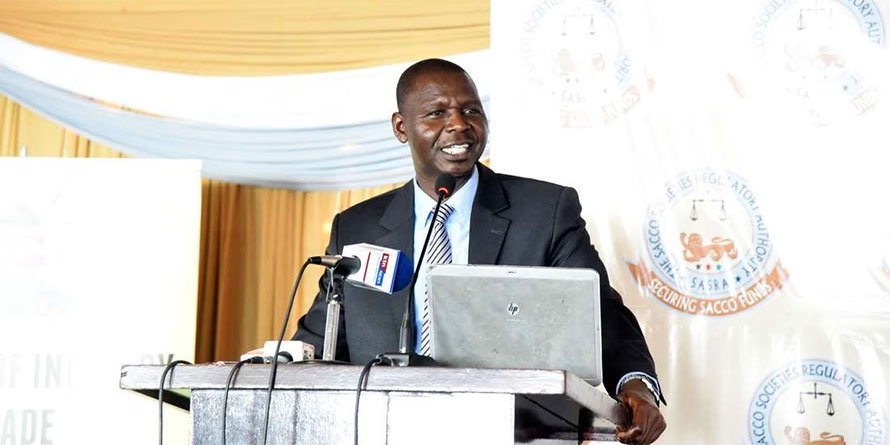
The regulator wants small Savings and Credit Cooperative Societies (Saccos) to merge as top 20 entities control more than half of the total deposits.
Read Insight →
An online currency trading company accused of operating illegally and defrauding Kenyans of millions of shillings tried to cut a deal with the Capital Markets Authority (CMA) to avoid prosecution.
Read Insight →
Kenyans will have to wait until after 2025 for petrodollars from Turkana oil fields to start trickling in after the government extended the exploration timeline for Tullow.
Read Insight →
Real-time bank transfers of more than Sh1 million recovered from a 26-month low to touch a new monthly record in July as authorities started easing Covid-19 trade and travel restrictions.
Read Insight →
Businesses and individual taxpayers have applied for waivers on tax penalties and interest amounting to Sh21 billion, an indication of their spirited effort to avoid property seizures and auction by the Kenya Revenue Authority (KRA) amid biting economic hardship due to the Covid-19 pandemic.
Read Insight →
Japan’s government has offered to give Kenya more than Sh3 billion grant to support energy projects and Universal Health coverage.
Read Insight →
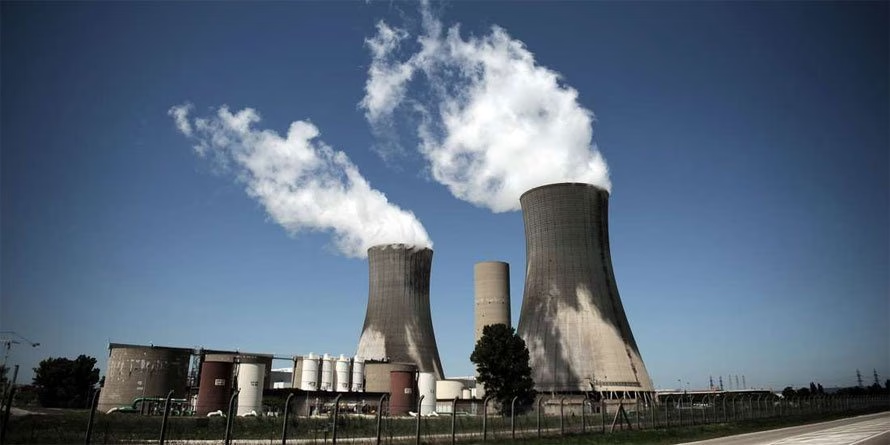
Kenya is set to build a $5 billion (Sh540 billion) nuclear power plant on a site in Tana River County over the next seven years with funding from private investors.
Read Insight →
A California court has given Uber and Lyft until the middle of next week to reclassify drivers as employees in compliance with new state law. The order came Monday when a judge granted a restraining order in a lawsuit filed by California attorney general Xavier Becerra and three cities including San Francisco, where Lyft and Uber are based.
Read Insight →
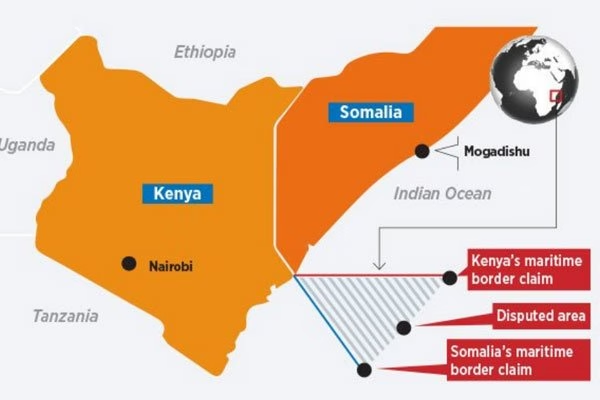
A three-judge bench has dismissed a petition to bar Kenya from participating before the International Court of Justice (ICJ) in a maritime dispute with Somalia.
Read Insight →
Bankers are set to keep all the property auction millions after the appellate court rejected efforts to reintroduce regulations that would have forced the lenders to pay capital gain tax.
Read Insight →
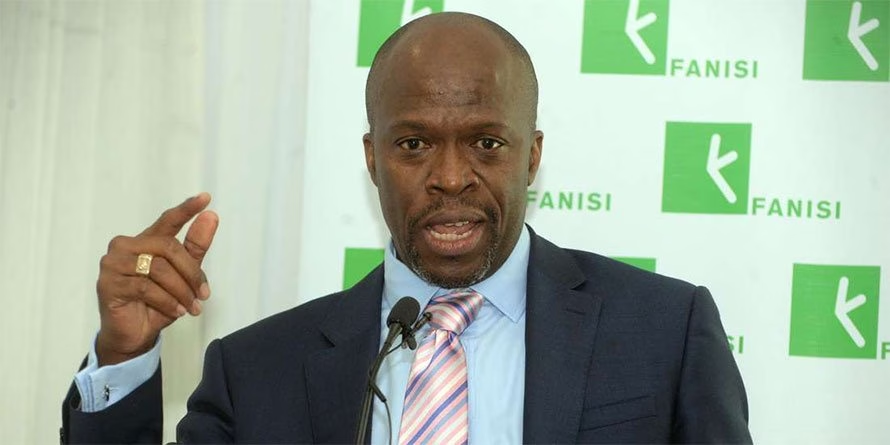
East Africa-focused private equity firms Fanisi Capital and Ascent Capital are set to merge and raise funds for bigger deals in the region. The two say consolidating their operations will help them to scale up and yield higher returns for investors.
Read Insight →